


The Arc of Texas Pooled trusts, is it worth it for you?
If you're setting up a special needs trust in Texas, you'll eventually run into two very different paths: a pooled special needs trust (like the one administered by the Arc of Texas) or an individual special needs trust drafted by an attorney just for your family member.
The short version: pooled trusts are cheaper and easier to maintain. Individual trusts cost more but give you far more control. Which one is "better" comes down almost entirely to how much money you expect to put into the trust over its lifetime.Here's the full breakdown.
What Is a Pooled Special Needs Trust?
In Texas, the Arc of Texas is the nonprofit that administers the pooled special needs trust and manages its investments. "Pooled" means your contribution is combined with the funds of everyone else in the trust.
This isn't as loose as it sounds — your dollars are still tracked as yours. But because the trust is investing a much larger combined pool of assets, it can access investment strategies and options that wouldn't make sense for a single, smaller account.
Fifty thousand dollars invested alone looks very different from fifty thousand dollars invested alongside a hundred other accounts.
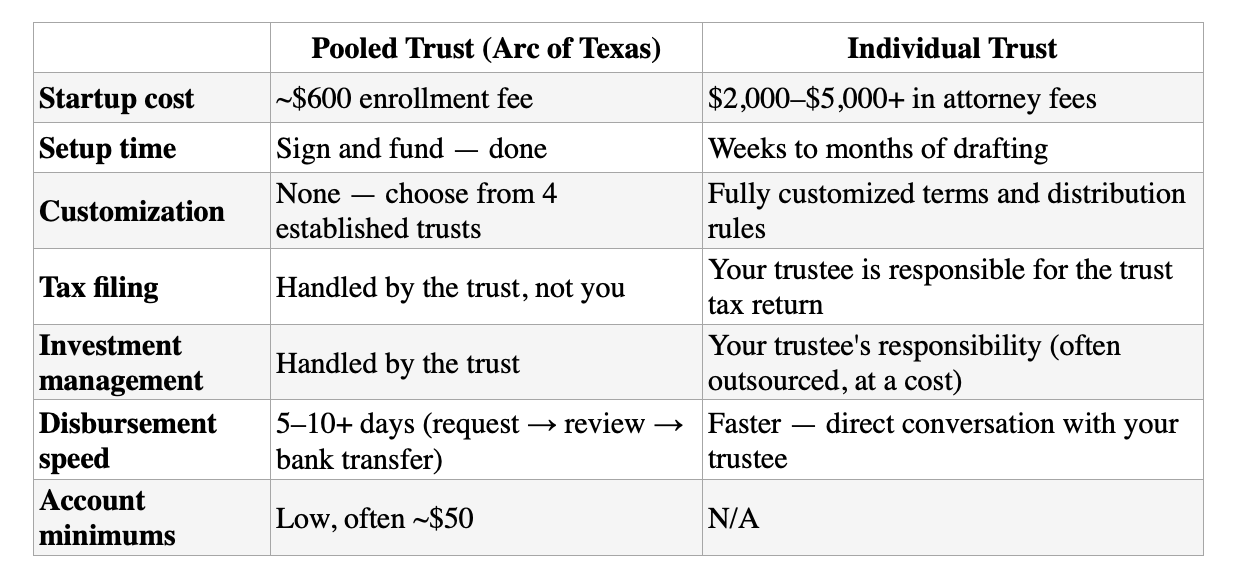
To join, you complete a joinder agreement — the trust's pre-established governing document. You don't get to negotiate or customize the terms; the Arc of Texas offers four established sub-trusts, already approved by the Social Security Administration, and you choose among them. Enrollment runs about $600, with low account minimums, often around $50.
What Is an Individual Special Needs Trust?
An individual (or standalone) special needs trust is built for one person only. You work directly with an attorney to draft the trust documents to your specifications — your terms, your distribution rules, your trustee.
That customization is exactly why it costs more. Drafting alone can take weeks, depending on the complexity of your family's situation, and the trust will need its own tax filings and its own designated trustee going forward.
Pooled vs. Individual SNT
Want to Know Which Trust Is For You?
We're fee-only advisors in Austin, TX, specializing in financial plans and asset management and tax preparation for clients with special needs family members. If you haven't looked at how a Special Needs Trust plays into your larger plan call here.
Schedule A Free Call
The Biggest Differentiator: Who Handles The Admin
Cost and setup time get most of the attention, but the administrative burden is arguably the bigger factor.
With a pooled trust, you never file a trust tax return — the trust is a separate entity, and the Arc of Texas handles both the tax filing and the investment management. That's a meaningful amount of ongoing work taken off your plate.
With an individual trust, all of that falls on your trustee. If you've named a family member — a sibling, for example — as trustee, they now need to either learn how to file a trust tax return or hire someone who can. Trust returns are notoriously complicated, and many CPAs won't touch them, which means you're often paying a premium for a specialist.
On top of tax prep, your trustee also needs to invest the trust assets well enough to last 20–30 years, which usually means bringing in investment management help — another ongoing cost.
None of this is a dealbreaker for an individual trust. It's just work that has to be done by someone, and that someone is either your trustee or a professional you hire.
Disbursement: Convenience vs. Control
Getting money out of a pooled trust means submitting a request, having it reviewed, and waiting for the funds to move from the trust to the bank — often 5 to 10 days, sometimes longer than a week end to end. (This is why, even if not required by the pooled trust, prepayment for funeral expenses is critical)
With an individual trust, you're talking directly to your trustee, who already knows the trust terms intimately. Disbursements tend to move faster simply because there's no institutional process to route through.
So Which Is For You?
This comes down almost entirely to how much money you expect to contribute to the trust over its lifetime — not just today's balance.
Under roughly $150,000 lifetime: A pooled trust is generally the better fit. The setup cost, ongoing tax prep, and investment management that come with an individual trust aren't worth it at this level. Pooled trusts are simpler to maintain and meaningfully cheaper over the long run.
Around $200,000 or more lifetime: An individual trust starts to make more sense. You gain more control over investment strategy, distribution terms, and disbursement speed — flexibility that becomes more valuable as the account grows.
These are general guidelines, not hard rules — every family's situation is different, which is exactly why this decision shouldn't be made in isolation.
Work With an Attorney and Planner Who Speaks This Language
None of this replaces legal advice. Special needs trusts are drafted and administered by elder law and special needs attorneys, and that relationship is essential no matter which path you choose.
Where financial planning comes in is everything around the trust: how contributions to a pooled or individual SNT interact with SSI and Medicaid eligibility, how the trust fits into the broader family financial plan, and how it's coordinated with tax preparation — especially if you end up needing specialized trust tax filing.
At Hamilton Financial Planning, financial planning, tax preparation, and investment management are handled in-house by one advisor, which matters when a family is weighing a decision like pooled vs. individual SNT — the tax, investment, and planning pieces don't get handled by three different people who've never spoken to each other.
If your family in Austin or Houston is trying to figure out which special needs trust structure fits your situation, schedule time or shoot me an email.
Thanks for reading.
This article is for educational purposes only and is not legal advice. Please consult a qualified elder law or special needs attorney before establishing any trust.