


One of the go-to tools Texans use for this is called a Ladybird deed — an enhanced life estate deed. Here's what you need to know.
If you or a loved one is receiving Medicaid, there's a rule you need to know about: the Medicaid Estate Recovery Program, or MERP. It's a federal requirement that every state administer, and Texas takes it seriously.
Here's how it works. Medicaid is a jointly funded program between the state and federal government. If you're receiving Medicaid benefits and you pass away, the state of Texas is legally required to go into your estate, review your assets, and seek repayment for the Medicaid services you received.
Why Your Home Is at Risk
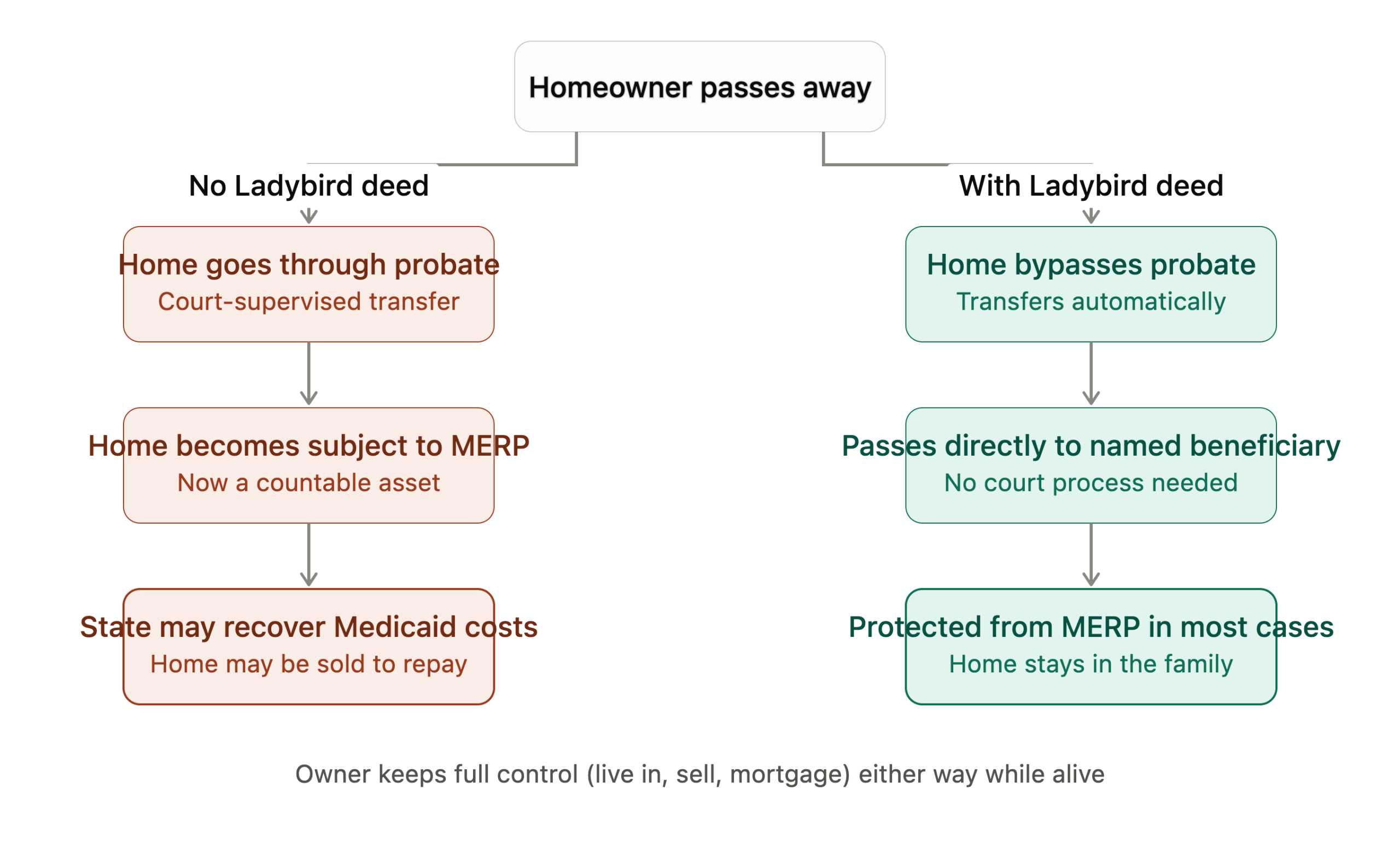
To qualify for Medicaid, you generally need to keep your countable assets under $2,000. Your home isn't counted toward that limit while you're alive — which is a relief for most families. But that protection ends at death. Once you pass away, your home suddenly becomes a countable asset and a target for recovery under MERP.
For a family that's held onto a home for generations, or one you're hoping to pass down to your kids or grandkids, this can come as an unwelcome surprise.
The Key to Avoiding MERP: Keep the House Out of Probate
MERP is triggered by probate — the legal process of distributing your estate to beneficiaries after you die. If you have a will, probate follows its terms; if you don't, the court decides. Either way, probate is simply the process of moving your assets to whoever inherits them.
The strategy many Texas families use: keep the house out of probate entirely. If the home never passes through probate, MERP has no path to reach it.
Passing Away With and Without a Ladybird Deed
Want to Know Which Method Is For You?
We're fee-only advisors in Austin, TX, specializing in financial plans and asset management and tax preparation for clients with special needs family members. If you haven't looked at how a Ladybird or Transfer on death deed can help you, schedule time to meet.
Schedule A Free Call
One Common Tool: The Ladybird Deed
One of the go-to tools Texans use for this is called a Ladybird deed — an enhanced life estate deed.
Here's what it does: you keep full control of your home while you're alive. You can live in it, mortgage it, or do anything else you'd normally do as the owner. But when you pass away, the home automatically transfers to whomever you named in the deed — without going through probate.
Because the transfer happens outside of probate, it also sidesteps MERP in most cases.
What This Means for Your Family
If you have a home you want to protect — especially one that's been in the family for years, or one you plan to leave to children, grandchildren, nieces, or nephews — a Ladybird deed is worth exploring with an estate attorney.
A quick note: I'm not an attorney, and this isn't legal advice. Talk with an estate attorney who can draft the right deed for your situation, and loop in a financial planner who can help you see how it fits into your broader financial and estate plan.
The bottom line
MERP targets assets that go through probate. If you want to keep your home in the family, structuring it to avoid probate — through a tool like a Ladybird deed — is one of the most effective ways to do that.
If you'd like to talk through how this fits into your overall financial plan, especially as part of planning for a family member with special needs, I'm happy to take a look with you. Reach out to schedule a conversation.
Thanks for reading.
This article is for educational purposes only and is not legal advice. Please consult a qualified elder law or special needs attorney before establishing any trust.