


There are 4 investment options when setting up a Texas ABLE account, here's a way to get an idea of which one you should pick.
If you're opening an ABLE account in Texas and want to invest the money rather than just let it sit, you'll run into four investment options: conservative, moderately conservative, moderate, and aggressive. The labels sound simple, but picking the right one isn't really about the label at all — it's about knowing your own personal risk number and matching it to the portfolio built for that number.
A Quick Refresher on ABLE Accounts
An ABLE account is a tax-advantaged account run by the state — most states offer one. The money can be used to pay for qualified disability expenses without jeopardizing state or federal benefits like SSI or Medicaid.
When you set one up, Texas ABLE gives you five options total: a bank savings account (FDIC-insured, for people who just want their money to stay safe) and four managed allocation portfolios with those verbal risk labels.

The Problem With Verbal Labels
"Conservative," "moderate," "aggressive" — these terms sound clear, but they're actually pretty subjective. What counts as a "moderately conservative" portfolio to the state program might look completely different than what you'd picture yourself. There's no shared definition.
Turning Subjective Labels Into a Number
To make this more concrete, I use a tool called Nitrogen (formerly Riskalize) that takes the actual investment allocations in each portfolio and assigns them a numerical risk score — from 0 (lowest risk) to 100 (highest risk). Here's how the four options actually break down:
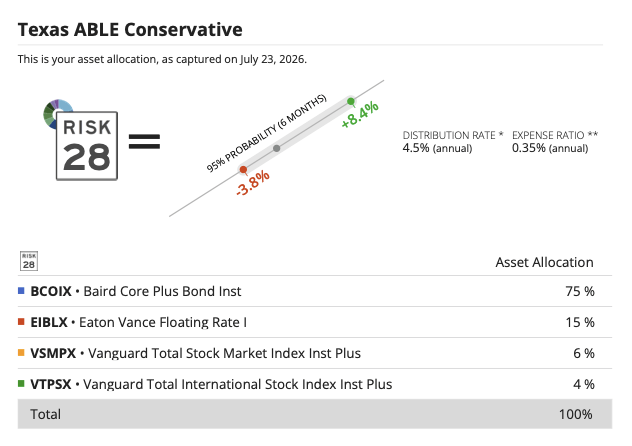
Conservative — risk score 28. This is the least risky portfolio out of all the investment options. It also carries the highest expense ratio of the bunch, at 0.35%. That might sound small, but an expense ratio like that compounds over years and decades — quietly eating into your returns the longer the money stays invested. This option is heavily weighted toward bonds with 90% in bonds and only 10% in stock funds.
Moderately conservative — risk score 35. Still bond-heavy at 75% bonds and 25% stocks split across two stock index funds.

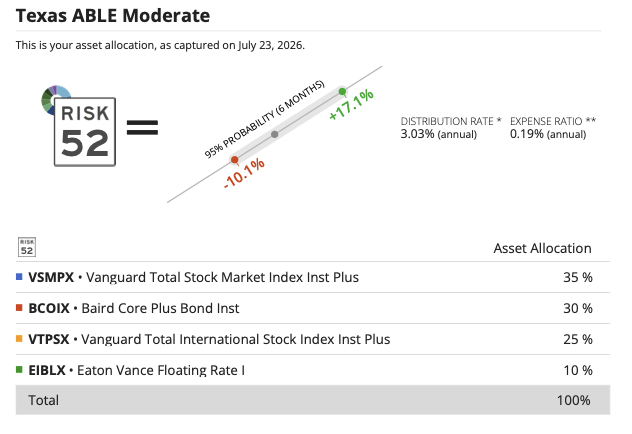
Moderate — risk score 52. This is the classic 60/40 portfolio: roughly 60% stocks (split between a US total market fund and an international fund) and 40% bonds.
Aggressive — risk score 62. With an expense ratio of 0.11% this is the lowest of the four. About 80% stocks (45% US total market, 35% international) and 20% bonds.
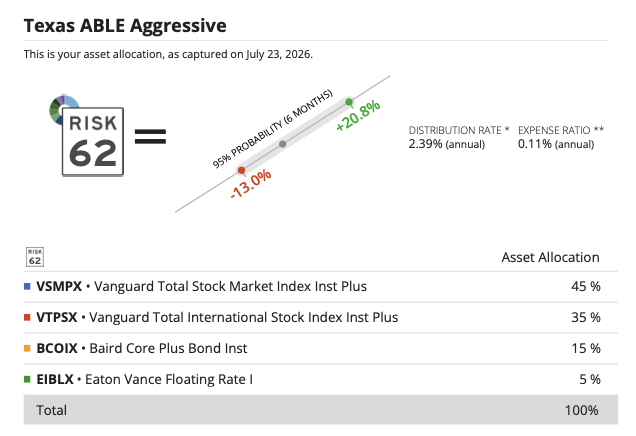
The pattern to notice as you move from conservative to aggressive: The spread between best-case and worst-case outcomes keeps widening, while the expense ratio keeps shrinking.
What does the spread mean? Explained simply, Over a 6-month window, Nitrogen estimates a 95% probability range of about -3.8% to +8.4% for the conservative portfolio, versus -13.0% to +20.8% for the aggressive portfolio.
Meaning the more aggressive the allocation the more variation in the possible returns.
Want to Know Which Investment Is For You?
We're fee-only advisors in Austin, TX, specializing in Tax Preparation, Financial Plans and Asset Management for clients with special needs family members. If you want more information on how you should be investing, schedule a free call here.
Schedule A Free Call
How To Find Which One Is Right for You?
Now that you know the risk numbers for the four portfolios, the next step is learning your own.
Finding your own risk number is as easy as taking a free questionnaire linked: HERE
Once you finish the questionnaire, a report will be generated that tells you your risk number. This risk number can then be compared to the risk numbers of the existing ABLE account investments so you can see which account you lean towards.
For example, if your risk number is 88, the aggressive allocation might be best for you since it has a risk score of 62, the closest match to you.
If your risk number is 43 then the Moderately Conservative or Moderate portfolio investments may be more your style.
Ultimately
You're not locked into picking just one since most ABLE programs let you blend allocations, say 50% aggressive and 50% conservative, if that fits your comfort level better once you know your number.
To be clear, this isn't personalized investment advice — you shouldn't take investment advice from anyone on YouTube, myself included. But your risk number is the one piece of information that actually makes this decision objective instead of a guess based on a label.
I hope this helps you in your decision making process.
Thanks for reading.